
Piedmont is the French side of Italy. It shaped the country’s history, determined its social structure, hosted its most powerful and symbolic industry — Fiat — and did so with figures largely formed in Paris. Think of Count Cavour, the key man of the Risorgimento, born a subject of Napoleon.
The great wine tradition, there’s no getting around it, comes from that same world. It grew from the long wave of transalpine culture — Burgundy, Bordeaux, Provence. People moved, and they brought their knowledge with them.
And so Barolo and Barbaresco became names that travelled through the European imagination before modern marketing ever turned them into brands. Every decent Dutch wine shop carries them. Every restaurant wine list that wants to look serious has at least one. Barolo is the Italian wine the North adopted, metabolised, understood just enough to feel comfortable.
Which is a problem, for a project like Sood that doesn’t want to sell things people already know.
So why Dogliani?
A general, a cellar, one hundred and sixty-six years
It begins in 1856. Domenico Dogliani — whom everyone calls il Generale, for reasons the family has never quite clarified, which only adds to the story — decides to turn a passion into a profession.
We are in Bussia Soprana, in the municipality of Monforte d’Alba. A hillside. A name. For anyone who knows Barolo, Bussia is not just anywhere: it is one of the most celebrated crus of the entire denomination, one of those places where the land does something specific to the Nebbiolo grape. Same difficult variety, same vocation for ageing, completely different climate.
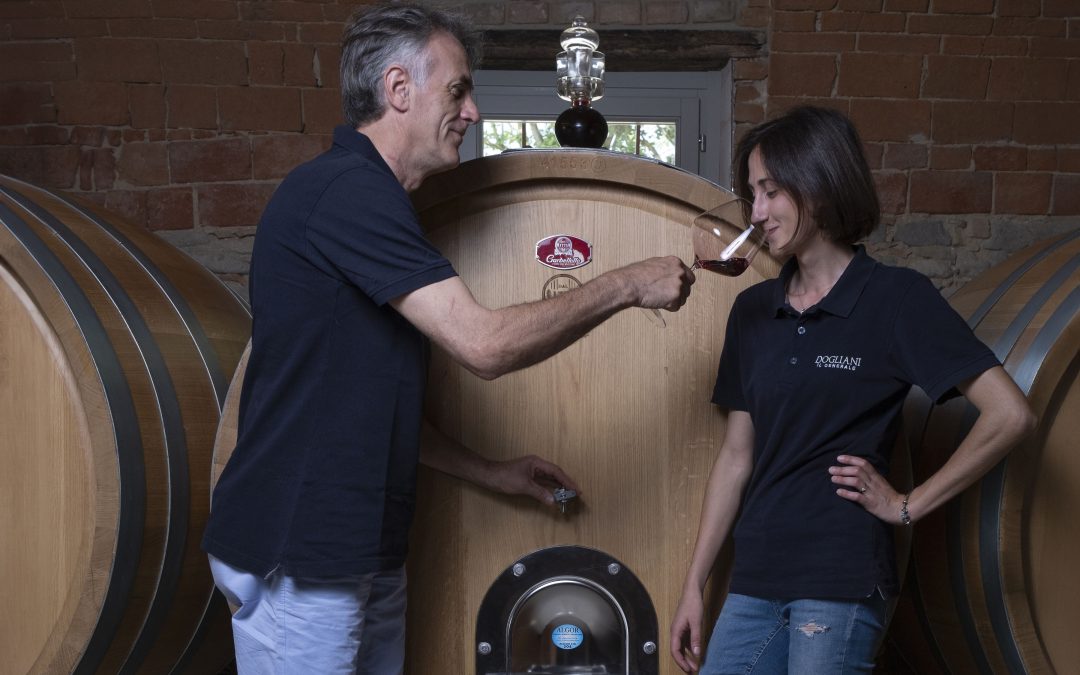
Five generations later, the winery still exists. Still in Bussia. And the fifth generation is already inside — with a winemaker, an agronomist, and a head of international development named Eleonora, who accompanies visitors through the cellar and receives the kind of reviews that people write when they mean it.
This is not a company that sold itself. Not a brand built by an investment fund. It is a family that has been making wine since the Netherlands did not yet have universal suffrage.
The French side of Italy
Piedmont borders France. That is not a geographical detail — it is an identity.
The Langhe have a character that the rest of Italian wine country does not: colder, foggier, more defined seasons. An austere elegance that has nothing to do with the warmth of southern wines. French Burgundy and Barolo have more in common than either side would like to admit.
Dogliani embodies this character. It does not make extrovert wines. It makes wines that need time — in the cellar, in the bottle, in the glass. The bottle you open tonight is different from the one you’ll open in two years. And the one in five years is another story entirely.
This is why Barolo and Nebbiolo are not for every evening. And this is exactly their greatness.
The wines — the road less taken
This is our angle on Dogliani. We won’t sell you the Barolo as if it were a discovery — you already know it, or you know where to find it. We’ll tell you about the wines from the same cellar, the same cru, the same family — wines that bring Bussia into the glass at a price that lets you open them without thinking too hard.
Nebbiolo d’Alba DOC
Same grape as Barolo. Same territory. Different rules — less mandatory ageing, more accessible, more immediate.
It is not a lesser Barolo. It is something else: Nebbiolo before time transforms it. Red and black fruits, spice, tannin present but not dominant. The wine you put on the table when you want Piedmont without ceremony.
In the Netherlands it works well with braised beef, aged cheese, anything that can hold its own without overpowering it.
Langhe DOC Favorita
The white that almost nobody outside Piedmont knows.
Favorita is an indigenous variety of the Langhe — it has no famous relatives, it is not related to anything you already know. Floral, slightly almond, with a fresh acidity that makes it perfect for aperitivo or a delicate first course.
It is the wine you want to have at home for the evenings when you don’t want to choose. You open it, you pour it, it works.
Barolo DOCG Bussia
If you want Barolo, this is Barolo from a cru that matters. Bussia Soprana is not just any MGA — it is one of the historic origins of modern Barolo.
We don’t recommend it to anyone who wants to drink tonight. We recommend it to anyone with a cellar, or the patience to wait. Opened too early, Barolo is tannic and closed. Opened at the right moment, it is one of the most complete experiences Italian wine can offer.
Tradition and the fifth generation
What convinced us about Dogliani was not the territory. It wasn’t even the wines, which are excellent but not the only excellent wines of the Langhe.
It was the way they are managing the generational transition.
Five generations in a wine estate inevitably means a tension between those who want to preserve and those who want to change. The fifth generation of Dogliani — with its winemaker, its agronomist, its international director — seems to have found a balance that neither betrays the roots nor fossilises on them.
Passion in evolution, as they say.
We recognise ourselves in that phrase. Sood is looking for the same balance: respect for what is old, curiosity for what comes next.
Why it’s worth it
Too many people already know Piedmont, we said.
But Dogliani il Generale is not the Piedmont everyone knows. It is a specific family, in a specific place, with a hundred and sixty-six year history that does not need marketing to be interesting.
You already know how this ends: we went to Bussia, we tasted, we decided it was worth telling.
That is what we do.
Dogliani wines are available at soodmarket.com — Nebbiolo d’Alba DOC, Langhe DOC Favorita and Barolo DOCG.
Next article: the Langhe, Bussia, and why a cru in Piedmont is worth as much as one in Burgundy.